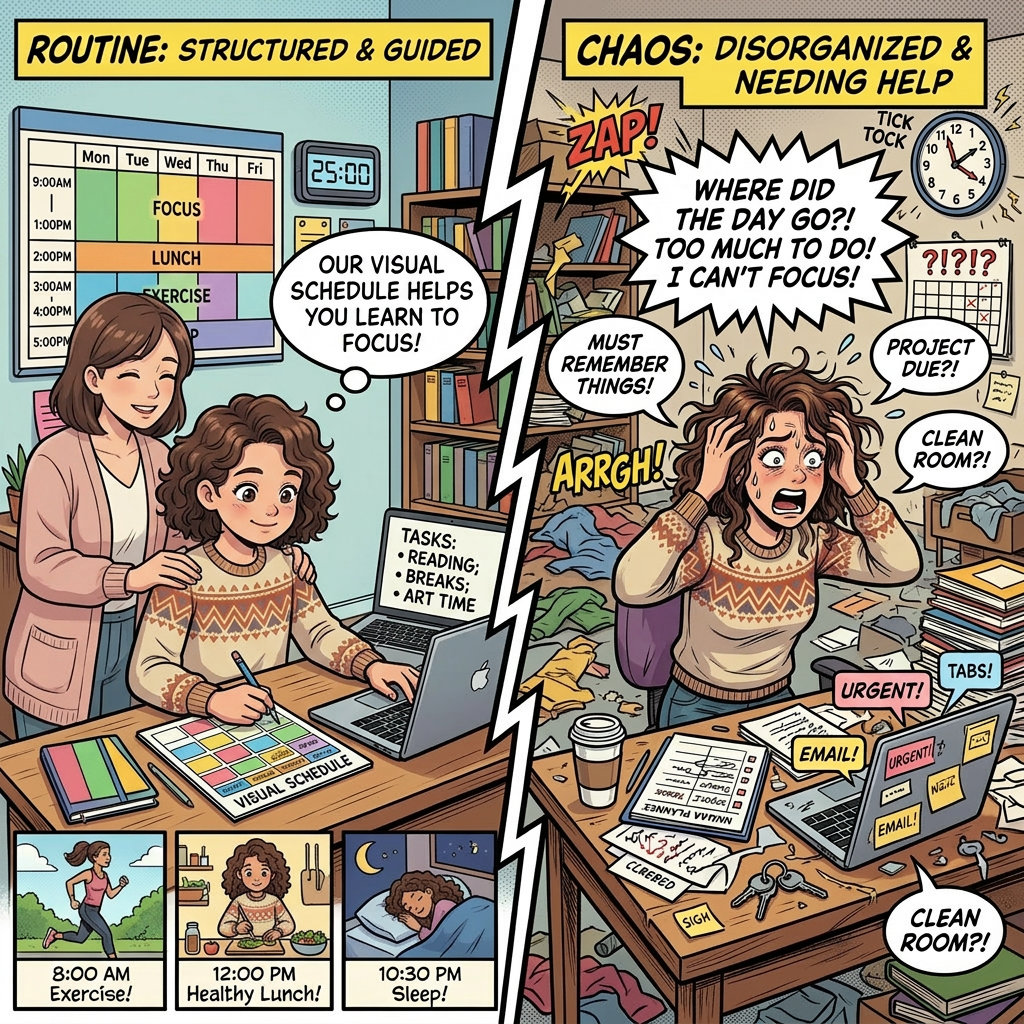
Discover why routines are essential for kids with ADHD and how to create simple, flexible systems that improve focus, reduce stress, and build confidence. Learn practical strategies for mornings, homework, and bedtime.
Why Routines Matter for Kids with ADHD
“As a child, routine gives us a feeling of safety. As adults, it gives us a feeling of purpose.” — Brianna Wiest
If you’re parenting a child with ADHD, you’ve probably noticed that daily life can feel unpredictable. One moment, your child is focused and engaged, and the next, they’re completely off track. This isn’t a lack of effort. It’s how the ADHD brain works.
Children with Attention-Deficit/Hyperactivity Disorder often struggle with attention, time management, and task completion. That’s why routines aren’t just helpful—they’re essential.
But here’s the key: routines for kids with ADHD shouldn’t feel rigid or restrictive. Instead, they should be flexible, supportive systems that guide your child while honoring how their brain functions.
As a parent, you set the tone. With the right approach, routines can transform chaos into calm and frustration into success.
Understanding the ADHD Brain and Routine Challenges
Before creating a routine, it’s important to understand what your child is up against.
Kids with ADHD often:
- Struggle to remember multi-step directions
- Experience time as “now” or “not now.”
- Have a low tolerance for boredom
- Need higher levels of stimulation or reward
- Find transitions especially difficult
This means that simply telling your child what to do—or repeating instructions—usually won’t work.
Instead, routines need to be:
- Visible
- Structured
- Broken into small steps
- Reinforced consistently
Think of routines as external supports for an internal challenge.
Start Small: Build Routines One Step at a Time
One of the biggest mistakes parents make is trying to fix everything at once.
Instead:
- Choose one or two goals
- Keep them simple and achievable
- Build success before adding more
For example, instead of “get ready for school,” break it down:
- Wake up
- Get dressed
- Brush teeth
- Eat breakfast
- Pack backpack
When routines are broken into manageable steps, your child is more likely to follow through—and feel successful.
Externalize Everything: Make Routines Visible
Children with ADHD often cannot hold a sequence of tasks in their minds. That’s why visual supports are powerful tools.
Try:
- Picture charts for younger children
- Written checklists for older kids
- Sticky notes as reminders
- Whiteboards for daily routines
Add checkboxes next to each task. This gives your child a sense of accomplishment as they move through their routine.
Timers are another essential tool. They help combat time blindness and make abstract concepts like “five minutes” more concrete.
Create Predictable Daily Anchors
Instead of trying to control every moment, focus on anchor points in the day.
Morning Routine
Mornings can be especially challenging.
Helpful strategies:
- Use music or TV shows as time cues
- Break tasks into small steps
- Keep the order consistent
- Prepare as much as possible the night before
Consistency matters more than perfection.
Homework Routine
Homework can feel like a battle—for both you and your child.
Make it easier by:
- Creating a distraction-limited workspace
- Starting with a quick planning session
- Using short work intervals (like 10 minutes on, 2 minutes off)
- Adjusting supervision based on your child’s needs
Some children benefit from a “body double”—simply having you nearby while they work.
End with a closing routine to signal completion.
Bedtime Routine
Bedtime struggles are incredibly common with ADHD.
Start thinking of bedtime as a nighttime routine that begins at least an hour before sleep.
Try:
- Lowering lights
- Turning off screens
- Playing calming music
- Engaging in quiet activities
Whether your child prefers complete silence or a sound machine, do what works best for them.
Better sleep leads to:
- Improved mood
- Better focus
- Reduced ADHD symptoms
Know Your Child’s Natural Rhythm
Every child has different energy patterns throughout the day.
Pay attention to:
- When your child is most focused
- When they’re mentally tired
- When they recover energy
Schedule demanding tasks during peak times and easier activities during low-energy periods.
Working with your child’s rhythm—not against it—makes routines far more effective.
Use Incentives to Boost Motivation
Rewards highly drive the ADHD brain.
Without an emotional connection, tasks can feel impossible.
Try:
- Reward systems
- Verbal praise
- Visual progress trackers
You can also ask:
“What will it feel like when you’re done?”
Helping your child imagine that positive feeling increases motivation and follow-through.
Teach Mental Rehearsal
Mental rehearsal is a powerful but often overlooked tool.
It involves:
- Visualizing completing a task
- Imagining each step
- Practicing success in the mind
This strengthens neural pathways and builds confidence.
Encourage your child to “practice in their brain” before starting a routine.
Expect Imperfection—and Use It as a Tool
Failure isn’t the problem—rigid expectations are.
Routines will:
- Break down
- Need adjustments
- Sometimes fail completely
That’s okay.
Use these moments to:
- Identify what didn’t work
- Adjust expectations
- Try again with new strategies
Progress, not perfection, is the goal.
Support Transitions and Time Management
Transitions are one of the hardest parts of ADHD.
Make them easier by:
- Giving warnings (“5 minutes left”)
- Using timers
- Adding buffer time between tasks
Always include grace periods. Things will take longer—and that’s normal.
Create an ADHD-Friendly Environment
Your home environment can either support or sabotage routines.
Helpful changes:
- Create a “launch pad” near the door for essentials
- Assign a home for frequently used items
- Label drawers and bins
- Reduce unnecessary distractions
The goal is to make the environment do some of the work.
Encourage Movement and Activity
Movement isn’t a distraction—it’s a tool.
Research and experience show that:
- 10 minutes of physical activity before a task improves focus
- Fidgeting can help with concentration
- Alternating tasks prevents burnout
Let your child move. It helps their brain engage.
Practice Conscious Parenting
Effective routine-building starts with awareness.
Focus on:
- Understanding how ADHD impacts behavior
- Adjusting expectations based on development
- Using positive, supportive communication
Think of yourself as a detective—learning what works best for your child.
Collaborate With Your Child
Routines work best when children feel involved.
Ask:
- What works for you?
- What feels hard?
- What would make this easier?
You may not always agree—but collaboration builds buy-in.
And buy-in increases success.
Final Thoughts: Routines Are Allies, Not Enemies
As Penn Holderness and Kim Holderness say, routines are not the enemy of ADHD—they’re allies.
When done right, routines:
- Reduce stress
- Increase independence
- Build confidence
Start small. Stay flexible. Keep going.
Because the truth is simple:
Life gets easier when your child knows what’s coming next.
Leave a Reply